
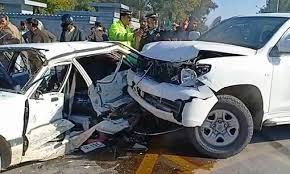
In the chilly night of February 1, 2021, Islamabad’s normally quiet Srinagar Highway became the scene of a tragedy that transcended a mere traffic collision. Headlights turned towards it, not for its headline-grabbing figures, but for the deeper questions it raised—about accountability, privilege, media scrutiny, and the value of human life in our society. At the center was Kashmala Tariq, then-Federal Ombudsperson for Protection against Harassment of Women at the Workplaces, her family members, and a convoy of protocol vehicles. The accident left four young men dead, multiple injured, and a nation demanding answers. This incident, popularly dubbed the Kashmala Tariq accident, resounded far beyond the highway, touching on themes of responsibility, elitism, and justice.
The Accident Night: What Exactly Happened
The Collision
Late on Monday night, as a convoy passed through Islamabad’s G-11 traffic signal, disaster struck. A white Lexus—part of a motorcade associated with Kashmala Tariq—ploughed into a Mehran carrying five men who had come from Mansehra to appear in an ANF exam. The crash also hit a passing motorcyclist.
Eyewitnesses and the FIR lodged at Ramna police station pointed a finger at the Lexus, alleging that it jumped the red light, causing massive carnage. Four passengers in the Mehran lost their lives instantly; a fifth survived with injuries. The motorcyclist was also injured.
Locals rushed to the scene, attempting to rescue victims and identify the driver. Their voices echoed accusations that it was Kashmala Tariq’s son behind the wheel.
Who Was in the Cars
Kashmala Tariq and her husband were seated in the driver’s Lexus, which was, she stressed, being driven by their professional driver. According to her account, they were returning from Lahore—she and her husband traveling together, while her son, accompanied by a police guard and another driver, followed in a Toyota Fortuner.
Tariq recounted waking up violently as the airbags deployed; she suffered a nose bleed, and her husband was also injured, remaining at the accident scene and calling for help. She denied that her son had driven the fatal vehicle, asking for CCTV footage to clarify the truth.
The Aftermath and The Fallout
Legal Action and Bail Proceedings
The police lodged an FIR naming Kashmala Tariq’s son, Azlan Khan, as the driver. The family’s driver was subsequently arrested, while Azlan secured bail before any arrest, against a security bond of Rs 50,000, valid until February 16.
During a press conference, Tariq reiterated her claim that neither she nor Azlan drove the Lexus. She asserted that both drivers may share responsibility due to speeding and insisted that media inferences unfairly cast blame on her family.
Media, Public Opinion, and “Media Trial”
The incident ignited a media firestorm. Tariq lamented being subject to a “media trial” and suggested that opposition to her work—such as refusing favoritism in cases—had motivated sensationalist coverage.
On Reddit and social media platforms, public sentiment ran hot. Emotional posts voiced outrage at what was seen as VIP immunity. In one instance, a user wrote:
“Currently an FIR is registered against son Azlaan who was according to eye witnesses driving the car… Instead of a formal apology this woman has the audacity to issue a statement where literally she talked about the trauma and suffering she had to endure.”
Others predicted the driver would take the fall while the rich would escape consequences:
“This is just like the movie ‘The White Tiger’… A driver will be accused and convicted of the crime.”
Their words reflected a distrust of institutional fairness and the belief that privilege shields those at the top.
Families’ Response—Compassion or Compromise?
Days later, some of the victims’ families submitted affidavits stating that they believed it was Tariq’s driver—not her son—behind the wheel. They expressed willingness to pardon both the driver and Azlan in the name of Allah and requested the case be quashed.
However, authorities clarified that all victims’ families would need to submit such pardons for the case to be closed—a procedural and moral nuance underscoring differing levels of grief, power, and persuasion.
Political Response
The Prime Minister at the time, Imran Khan, took notice. His information minister, Shibli Faraz, condemned the accident and called for the end of protocol culture—where flashy convoys serve more for status than security. Officials promised reforms to ensure protocol was not used as privilege.
What This Accident Tells Us: Key Themes and Reflections
Protocol vs. Public Safety
The accident starkly highlighted how protocol convoys, often privileged for their occupants, may undermine public safety. The Lexus, allegedly speeding through a red light, speaks to a culture where official protection sometimes doubles as reckless entitlement.
Justice, Power, and Perception
The swift bail, the arrest of a driver, and not the son, and the narratives of families pardoning accused individuals fueled public perception of unequal justice. This conflict between legal process and public sentiment is potent terrain for debate, especially in societies seen as highly stratified.
The Burden of Truth in Media
Tariq’s claim of a media trial underscores how emotions, assumptions, and partial narratives can shape public opinion before courts weigh in. Media, in the digital age, often runs ahead of investigation—sometimes to the detriment of all involved.
Forgiveness and Religious Context
The families’ lived decision to pardon the accused—including Tariq’s son—invokes Islamic traditions around forgiveness, Qisas and Diyat, and community reconciliation. Yet, the legal system requires procedural completeness, making the gap between personal forgiveness and justice complex.
See Also: https://bepakistani.world/who-was-the-first-governor-general-of-pakistan/
FAQs: Understanding the Kashmir Tariq Accident
Below are ten frequently asked questions, answered comprehensively:
- What exactly happened in the Kashmala Tariq accident?
A convoy of SUVs, including a Lexus and a Fortuner tied to Kashmala Tariq’s protocol, allegedly ran a red light at G-11 on Srinagar Highway, colliding with a Mehran carrying five ANF aspirants. Four died; one was injured, as was a motorcyclist. - Who was driving the Lexus at the time of the crash?
The FIR named her son, Azlan Khan, as driver. Kashmala Tariq claims the Lexus was driven by their staff driver, not her son, who she says was in a following vehicle. - Were any family members injured?
Both Tariq and her husband sustained injuries. She suffered a nosebleed and bandaging, while her husband was also hurt and later taken to hospital. - What legal action was taken?
An FIR was registered naming Azlan as driver, the family driver was arrested, and Azlan was granted bail before arrest for Rs 50,000. - How did public and social media react?
Many expressed outrage, seeing this as emblematic of elite protection and poor accountability. Some called for justice; others highlighted how the narrative may be skewed by privilege. - Did the victims’ families respond or forgive?
Yes. Two families filed affidavits requesting the case be quashed, stating they believed it was the driver, not the son, and pardoning both accused “for the sake of Allah”. - Did the government take any steps?
The Prime Minister condemned the protocol culture that prioritizes appearance over safety. Reforms were promised to curb misuse of protocol privileges. - Has CCTV footage been released?
Tariq called for CCTV footage from Islamabad’s Safe City system to be released for clarity. As of initial reports, it had not been made public. - What broader implications does the accident have on society?
It raises questions about VIP accountability, road safety, justice for the powerless, media ethics, and laws around forgiveness and interpersonal conflict resolution. - Has this incident had lasting legal or policy consequences?
The Prime Minister’s public condemnation and the spotlight on protocol misuse suggest a push for culture shift. However, tangible legal or procedural reforms would require further follow-up beyond immediate media coverage.
Conclusion: After the Crash, a Mirror to Society
The Kashmala Tariq accident was more than a tragic collision—it was a mirror reflecting the anxieties and tensions of a complex society: justice versus privilege, forgiveness versus procedural rigor, narrative versus evidence. It raised public anguish about elite impunity, but also showcased the power of personal compassion through the families’ pardons. It revealed flaws in media haste, the fragility of safety on our roads, and the enduring gap between those in authority and those who pay the ultimate price.
Moving forward, the test for institutions will be whether reforms outlast headlines: whether Safe City footage is used responsibly, whether protocol is reformed, and whether courts and society can balance compassion with accountability. Above all, this accident must prompt reflection: that every life has value, regardless of who stands beside it—and that justice must serve the many, not just the few.



Leave a Reply